


Simon Heijdens
"Simon Heijdens focuses his practice on the concept of coincidence and the return to unplanned natural processes in the artificial man-made environment that surround us in daily life. Using unique self-developed materials and technologies, he creates mechanisms to show the essence of a place that tends to go unnoticed. His artworks undergo constant changes and development based on their environment, influenced by factors like weather conditions such as sunlight and wind, as well as interactions with people. While technically complex, Heijdens’ installations are understated and poetic in their appearance, gracefully balancing between the visible and the invisible, and seamlessly integrate into their environment."
Shade(2010)


'Shade is a spatial projection of augmented sunlight.
A responsive glass of triangular sunlight apertures that open and close when wind moves over the outside surface of the glass, creating a living pattern of light that restores a natural flux to the otherwise perpetual man-made environment.
The glass transfuses light varyingly throughout the day along with the sunlight changing from sharp and graphic in the morning to diffused and ambient in the afternoon. Wind gusts that pass the outside surface of the glass trigger the triangular cells in the glass to turn from opaque to clear, and thereby either passing or blocking sunlight. As the apertures open and close, they together create a moving, dimensional projection of light and shadow onto the floors and walls of the interior space, that reveals the wind patterns that pass outside.'
Lightweeds(2005)

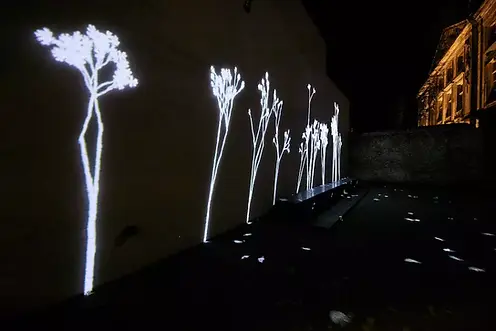


'Lightweeds is an ecosystem of living digital plants that overgrow the man-made space, moving and growing directly according to outdoor weather patterns. The projected silhouettes emerge from a digital seed containing unique genetic data of a plant species, which germinates in direct response to rainfall and sunshine measured by weather sensors in real-time, and moves along actual wind.
When people pass, the plants tremble and eventually loose their seeds which pollinate in the direction of passage. In their continuous cycle of growth and decay, the plants location and density reveals the way the building is used.'
What interests me about Shade is how Heijdens makes something invisible, such as wind, visible through its effects on an interior space. Although the wind exists outside the building, its movement becomes apparent through the changing patterns of light and shadow indoors. This challenges the idea that interior and exterior environments are entirely separate, suggesting that the outside world continues to influence a space even when it is enclosed.
I also find it interesting that the installation changes the appearance of the room without physically changing its contents. The same walls, floors and objects can be perceived differently depending on the light falling across them. This suggests that our understanding of an environment is not determined solely by what exists within it, but also by external conditions that influence how we experience it.
In relation to my own work, I could explore how natural light and shadows create visual connections between indoor and outdoor environments. Rather than photographing the outdoors directly, I could capture evidence of its presence within interior spaces. This could involve photographing sunlight falling across household objects, shadows cast by trees through windows, or the changing atmosphere of a room throughout the day. I particularly like the idea that the outdoor environment can become part of an indoor photograph without actually appearing in the frame.
I think Lightweeds explores a similar connection, but in a slightly different way. Whereas Shade reveals the direct influence of natural conditions on an interior, Lightweeds uses those conditions to create something that would not otherwise exist there. The projected plants are artificial, yet their behaviour is determined by real environmental changes. I find this contrast particularly interesting because it raises questions about what makes an environment feel natural or connected to nature.
The installation also introduces a relationship between people and their surroundings. As people move through the space, they influence the plants, while the plants themselves respond to conditions outside the building. This creates an interconnected system in which human activity, artificial imagery and natural environments all influence one another. The work suggests that connection is not necessarily something we can see directly, but something we can recognise through the effects that different elements have on each other.
In relation to my photography, Lightweeds has encouraged me to think about how an interior can contain evidence of something beyond its physical boundaries. I could explore this idea through photography by considering how outdoor conditions influence the atmosphere, appearance or interpretation of indoor spaces. I am also interested in the contrast between natural and artificial elements, and how their relationship can change the way we perceive an image.
Researching Heijdens has helped me build on the idea of connection as something that can exist through influence rather than physical proximity or visual similarity. Two environments do not necessarily need to be shown together for a relationship between them to become apparent.
This is particularly relevant to my developing ideas about how images communicate meaning. An indoor photograph might initially appear to be entirely about the objects or space it depicts, but details such as light, shadows and atmosphere can suggest the presence of an environment beyond the frame. I am interested in how these subtle details could encourage a viewer to imagine what exists outside the photograph, and whether presenting images alongside one another could strengthen or change those interpretations.
Heijdens has also made me consider the difference between documenting a connection and creating one. His installations actively translate outdoor conditions into indoor experiences, whereas photography could allow me to capture existing relationships or construct new ones through the way I frame, sequence and present images.